
M79.606

M79.606: Pain in leg, unspecified

The ICD-10-CM code for leg pain documented without a stated side, carrying the FY2027 inclusion term Pain in lower limb NOS.

Billable
FY2027

TABLE OF CONTENTS

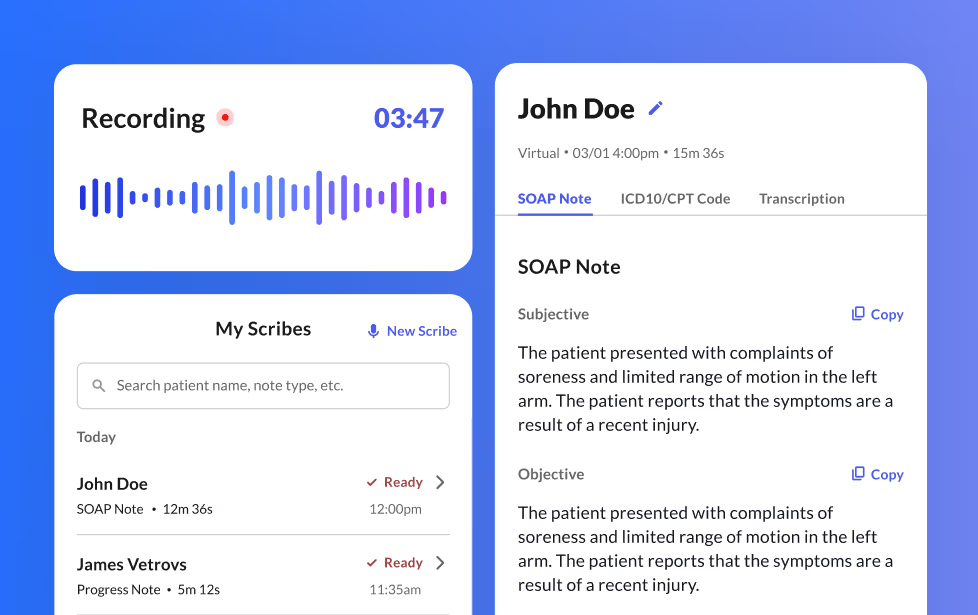
Medical scribe app interface showing a recording waveform, a list of patient notes, and a SOAP note for John Doe.

Stop looking up codes.

Scribe auto-generates them for you.

Try Commure Scribe →

At a glance

Code Family

M79.6: Pain in limb, hand, foot, fingers and toes.

DRG Grouping

MS-DRG 555 or 556, signs and symptoms of musculoskeletal system and connective tissue with or without MCC, in MDC 08 under the FY2027 MS-DRG v44 grouper.

HCC Mapping (v28)

None. M79.606 is a symptom code and no code in subcategory M79.6 maps to a CMS-HCC v28 category.

Condition

Leg pain

Family Specificity

Subcategory M79.60 runs both limbs through one series of digits: 1, 2 and 3 are the arm, 4, 5 and 6 are the leg, and 9 is the unspecified limb. Subcategories M79.65 and M79.66 split the leg again into thigh and lower leg.

Billable

Yes. M79.606 is a valid billable code requiring no further characters.

Which M79.60 code do I assign?

Subcategory M79.6 splits twice: first on which limb and which side, then on which segment of that limb the note names. M79.606 sits at the head of the leg branch, with the leg named and the side left open.

When documentation says…
Code
"Leg pain" or "lower limb pain" with no side stated
M79.606
Pain in leg, unspecified. The FY2027 tabular carries Pain in lower limb NOS as the inclusion term at this code. The note must name the leg or the lower limb. It must state no side, name no segment such as thigh or calf, and establish no definitive diagnosis for the pain.
Right leg pain
M79.604
Pain in right leg. The record states the side. One word in the assessment moves the encounter out of M79.606.
Left leg pain
M79.605
Pain in left leg. The sixth character 5 is the left leg, not an unspecified value. M79.604 and M79.605 are laterality siblings of M79.606, not more general codes.
"Arm pain" with no side stated
M79.603
Pain in arm, unspecified. Subcategory M79.60 mixes both limbs in one run of digits: M79.601 is the right arm, M79.602 the left arm, M79.603 the arm with no side, M79.604 the right leg, M79.605 the left leg and M79.606 the leg with no side. The digits are not a specificity ladder.
"Limb pain" or "extremity pain" with no limb named
M79.609
Pain in unspecified limb. The inclusion term at this code is Pain in limb NOS. M79.609 gives up the limb as well as the side, which places it below M79.606 in specificity. It is not a synonym for M79.606 and is not a substitute for it where the record says leg.
"Thigh pain" or "anterior thigh pain"
M79.659
Pain in unspecified thigh. Naming the thigh moves the encounter out of M79.60 and into M79.65. The laterality digits change at this level: M79.651 is the right thigh and M79.652 is the left thigh.
"Calf pain", "shin pain" or "lower leg pain"
M79.669
Pain in unspecified lower leg. Naming the segment below the knee moves the encounter into M79.66. M79.661 is the right lower leg and M79.662 is the left lower leg. There is no M79.6 code for the knee itself, which is classified to the M25.56- codes for pain in knee.

Tabular notes

EXCLUDES1

Category M79 carries two Excludes1 notes: psychogenic rheumatism (F45.8) and soft tissue pain, psychogenic (F45.41). Excludes1 means the two are not reported together for the same condition. Where the provider documents the limb pain as psychogenic, the F45 code replaces M79.606 rather than joining it. Subcategory M79.6 carries no Excludes1 note of its own. M79.606 carries none either.

EXCLUDES2

Subcategory M79.6 carries one Excludes2 note: pain in joint (the M25.5 codes). Subcategory M25.5 carries the mirror note for pain in limb (the M79.6 codes). Excludes2 means the patient may carry both conditions at once. A record documenting knee pain alongside separate diffuse leg pain may be assigned a code from M25.56- together with M79.606. Chapter 13 adds chapter level Excludes2 notes for injury, poisoning and certain other consequences of external causes (S00-T88), for symptoms, signs and abnormal clinical and laboratory findings, not elsewhere classified (R00-R94), and for traumatic compartment syndrome, the T79.A codes.

USE ADDITIONAL

Chapter 13 carries a chapter level instruction: use an external cause code following the code for the musculoskeletal condition, if applicable, to identify the cause of the musculoskeletal condition. Category M79 carries no Use Additional instruction of its own. It carries no Code Also and no Code First instruction either.

FY2027: EFFECTIVE 1 OCTOBER 2026

M79.606 is unchanged in the FY2027 update. The FY2027 codes addenda add, delete or revise no code in subcategory M79.6. Its descriptor, its inclusion term Pain in lower limb NOS and the Excludes notes above it were not revised for FY2027.

Operational & financial impact

Why specificity matters beyond the chart: risk adjustment, DRG assignment and denial exposure all follow from which code is selected.

CMS-HCC v28 (PY2024+)

M79.606 carries no CMS-HCC v28 mapping.

No code in subcategory M79.6 maps to a v28 category. Adding the side, or stepping down to thigh or lower leg, changes nothing in a Medicare Advantage risk score.

The v28 categories in the musculoskeletal area include HCC 92 for bone, joint, muscle and severe soft tissue infections and necrosis, HCC 93 for rheumatoid arthritis and other specified inflammatory rheumatic disorders, and HCC 94 for systemic lupus erythematosus and other specified systemic connective tissue disorders. Limb pain falls in none of the three. Neither do the sciatica codes M54.30 through M54.32 or the lumbago with sciatica codes M54.40 through M54.42, which sit in the dorsalgia category M54.

Where the workup establishes a vascular diagnosis, the risk adjustment picture changes. HCC 267 in v28 is Deep Vein Thrombosis and Pulmonary Embolism, which carries the acute lower extremity deep vein thrombosis codes in the I82.4- range. HCC 263 is Atherosclerosis of Arteries of the Extremities with Ulceration or Gangrene. HCC 264 is Vascular Disease with Complications.

CMS calculates 100 percent of CY2026 risk scores using the 2024 CMS-HCC model, completing the three year phase in, per the CY2026 Medicare Advantage and Part D Rate Announcement.

MS-DRG v44 (FY2027)

MS-DRG 555: signs and symptoms of musculoskeletal system and connective tissue with MCC.

MS-DRG 556: signs and symptoms of musculoskeletal system and connective tissue without MCC.

An inpatient admission with M79.606 as the principal diagnosis groups to MS-DRG 555 or 556 under the FY2027 MS-DRG v44 grouper, in MDC 08.

The pair splits on MCC alone. There is no CC tier between 555 and 556.

M79.606 carries no CC or MCC designation of its own. Reporting it as a secondary diagnosis does not move an admission from 556 to 555.

Medicare and commercial payers

M79.606 is a billable code and is valid on a claim when the record supports no more specific code.

The FY2027 ICD-10-CM Official Guidelines, section I.B.13, state that if the side is not identified in the medical record, the code for the unspecified side is assigned. That is the direct authority for M79.606 over M79.604 and M79.605.

Section I.B.4 states that codes describing symptoms and signs are acceptable for reporting purposes when a related definitive diagnosis has not been established by the provider.

Section I.B.5 states that signs and symptoms associated routinely with a disease process should not be assigned as additional codes, unless the classification instructs otherwise. Once sciatica, intermittent claudication or deep vein thrombosis is confirmed, the leg pain belongs to that diagnosis.

Section I.B.18 states that unspecified codes have acceptable, even necessary, uses. Each encounter is coded to the level of certainty known for that encounter.

M79.606 names no side. It cannot carry the laterality that a side specific procedure code asserts.

WHERE SPECIFICITY IS LOST

M79.606 gives up the side. One word in the assessment recovers it, at M79.604 or M79.605.

It also gives up the anatomical level. Thigh and lower leg each carry their own subcategory, M79.65 and M79.66. The knee is classified outside M79.6 entirely, to the M25.56- codes.

The larger loss is diagnostic. Leg pain is a symptom. The conditions that produce it carry their own codes.

Sciatica is the substitution to check first. Where the provider documents radicular pain in the sciatic distribution, M54.30, M54.31 or M54.32 applies. Where low back pain is documented together with the sciatica, M54.40, M54.41 or M54.42 applies instead, under the Excludes1 note at M54.3 for sciatica with lumbago.

Subcategory M54.3 carries further Excludes1 notes that route the encounter elsewhere. Sciatica due to an intervertebral disc disorder is classified to the M51.1- codes. A documented lesion of the sciatic nerve is classified to the G57.0- codes. Lumbar or lumbosacral disc degeneration with lower extremity pain only is classified to M51.361 or M51.371.

Where exertional calf pain relieved by rest is attributed to peripheral arterial disease, the I70.21- codes name the atherosclerosis, the claudication and the leg. M79.606 names none of the three.

Where acute unilateral leg pain and swelling is attributed to deep vein thrombosis, the I82.4- codes name the vein and the side.

The loss does not reach the risk score inside chapter 13. No M79.6 code carries a v28 HCC.

SEVERITY DESIGNATION (MS-DRG V44.0)

M79.606 carries no severity designation. It appears in neither Appendix G, the CC list, nor Appendix H, the MCC list, of the ICD-10 MS-DRG Definitions Manual Version 44.0. A case reaches the higher tier of its DRG pair on a designation carried by another diagnosis.

Documentation checklist to support M79.606

Chart elements that support code selection and reduce specificity-driven denials.

FAQ

Is M79.606 a billable ICD-10-CM code?

Yes. M79.606 is a valid billable code and requires no further characters. It is the most specific code available when the record names the leg and states no side. The FY2027 tabular carries Pain in lower limb NOS as its inclusion term.

What is the difference between M79.606 and M79.609?

M79.606 names the leg and leaves the side open. M79.609 leaves the limb itself open, under the inclusion term Pain in limb NOS. M79.609 is a further loss of specificity below M79.606, not a synonym for it. Subcategory M79.60 mixes both limbs in one run of digits: M79.601, M79.602 and M79.603 are the arm, M79.604, M79.605 and M79.606 are the leg, and M79.609 is the unspecified limb. Assign M79.609 only where the record does not say which limb.

When do I step down from M79.606 to M79.65 or M79.66?

Step down from M79.606 as soon as the note names a segment of the leg. Thigh pain is classified to M79.651, M79.652 or M79.659. Calf, shin and lower leg pain are classified to M79.661, M79.662 or M79.669. The laterality digits differ from the M79.60 run: 1 is the right side, 2 is the left side and 9 is unspecified at both M79.65 and M79.66.

Should documented leg pain be coded to M79.606 or to sciatica?

Leg pain is coded to sciatica where the provider documents sciatica. Radicular pain in the sciatic distribution is classified to M54.30, M54.31 or M54.32. Low back pain documented together with the sciatica is classified to M54.40, M54.41 or M54.42, under the Excludes1 note at M54.3 for sciatica with lumbago. Sciatica attributed to an intervertebral disc disorder is classified to the M51.1- codes. A documented lesion of the sciatic nerve is classified to the G57.0- codes. Both of those routes follow Excludes1 notes at M54.3. M79.606 is correct only where no such diagnosis has been established.

Does M79.606 affect risk adjustment or inpatient severity?

No. M79.606 carries no CMS-HCC v28 mapping. No other code in subcategory M79.6 carries one. M79.606 also carries no CC or MCC designation. MS-DRG 555 and 556 split on MCC alone. There is no CC tier between them. Risk adjustment and inpatient severity are separate questions. M79.606 reaches neither.

How is M79.606 reported on an inpatient claim compared with an outpatient claim?

The code selection rule is the same in both settings. As a principal diagnosis M79.606 groups to MS-DRG 555 or 556 under the FY2027 MS-DRG v44 grouper, in MDC 08. Section I.B.4 of the FY2027 Official Guidelines accepts a symptom code for reporting when a related definitive diagnosis has not been established. It notes that Chapter 18 contains many, but not all, codes for symptoms. The difference is how uncertainty is handled. An outpatient encounter codes only the confirmed diagnosis, under section IV.H. An inpatient discharge diagnosis documented as probable or suspected may be coded as though confirmed.

How do I sequence M79.606 with a category G89 pain code?

It depends on why the patient is there. Where the encounter is for pain control or pain management, the category G89 code is sequenced first, followed by M79.606 as the site of pain. Where the encounter is for any other reason and no related definitive diagnosis has been established, M79.606 is sequenced first, followed by the G89 code. The FY2027 Official Guidelines also state that a G89 code is not assigned where the underlying definitive diagnosis is known, unless the reason for the encounter is pain control or pain management.

Did M79.606 change in FY2027?

M79.606 is unchanged in the FY2027 update, effective 1 October 2026. The FY2026 update, effective 1 October 2025, also left the descriptor, the inclusion term and the Excludes notes at M79.606 and M79.6 unchanged.

Related codes

Codes in the same family as M79.606. Only codes with a published page render as links.

Sibling codes in the M79.6 family

  • M79.604: Pain in right leg.
  • M79.605: Pain in left leg.
  • M79.609: Pain in unspecified limb.
  • M79.601: Pain in right arm.
  • M79.602: Pain in left arm.
  • M79.603: Pain in arm, unspecified.
  • M79.651: Pain in right thigh.
  • M79.652: Pain in left thigh.
  • M79.659: Pain in unspecified thigh.
  • M79.661: Pain in right lower leg.
  • M79.662: Pain in left lower leg.
  • M79.669: Pain in unspecified lower leg.
  • M79.671: Pain in right foot.
  • M79.672: Pain in left foot.
  • M79.673: Pain in unspecified foot.

Additional codes to consider

Codes outside the M79.6 family considered alongside M79.606.

Companion: code alongside when documented

  • G89.29: Other chronic pain, when chronic pain is documented, under Guideline I.C.6.b.1.(b).
  • G89.21: Chronic pain due to trauma, under the same guideline.
  • G89.4: Chronic pain syndrome, only when the provider documents that condition, under Guideline I.C.6.b.6.
  • M25.569: Pain in unspecified knee, permitted alongside M79.606 under the Excludes2 note at M79.6.
  • M25.559: Pain in unspecified hip, under the same Excludes2 note.

Consider instead

  • M54.30: Sciatica, unspecified side, where radicular pain in the sciatic distribution is documented and the side is not.
  • M54.31: Sciatica, right side.
  • M54.32: Sciatica, left side.
  • M54.40: Lumbago with sciatica, unspecified side, where low back pain is documented together with the sciatica.
  • M54.41: Lumbago with sciatica, right side.
  • M54.42: Lumbago with sciatica, left side.
  • M51.17: Intervertebral disc disorders with radiculopathy, lumbosacral region, where the sciatica is attributed to a disc disorder, which M54.3 excludes under an Excludes1 note.
  • M51.16: Intervertebral disc disorders with radiculopathy, lumbar region.
  • M51.371: Other intervertebral disc degeneration, lumbosacral region with lower extremity pain only.
  • M54.17: Radiculopathy, lumbosacral region.
  • G57.00: Lesion of sciatic nerve, unspecified lower limb, which M54.3 excludes under an Excludes1 note.
  • M48.062: Spinal stenosis, lumbar region with neurogenic claudication.
  • I70.219: Atherosclerosis of native arteries of extremities with intermittent claudication, unspecified extremity.
  • I70.211: Atherosclerosis of native arteries of extremities with intermittent claudication, right leg.
  • I70.212: Atherosclerosis of native arteries of extremities with intermittent claudication, left leg.
  • I73.9: Peripheral vascular disease, unspecified.
  • I82.409: Acute embolism and thrombosis of unspecified deep veins of unspecified lower extremity.
  • I82.402: Acute embolism and thrombosis of unspecified deep veins of left lower extremity.
  • M79.A29: Nontraumatic compartment syndrome of unspecified lower extremity.
  • T79.A29A: Traumatic compartment syndrome of unspecified lower extremity, initial encounter.
  • M79.10: Myalgia, unspecified site.
  • M79.7: Fibromyalgia.
  • E11.42: Type 2 diabetes mellitus with diabetic polyneuropathy.
  • R52: Pain, unspecified, where the record documents pain without naming a site.

Sources

All claims on this page derive from government and professional-standards sources.

Stop looking up codes. Scribe generates them for you.

Commure Scribe listens to your visit and auto-generates billing codes, no manual lookup.