
R53.1

R53.1: Weakness

The ICD-10-CM code for weakness when reduced strength is the presenting complaint and no definitive cause has been established at the time of the encounter.

Billable
FY2027

TABLE OF CONTENTS

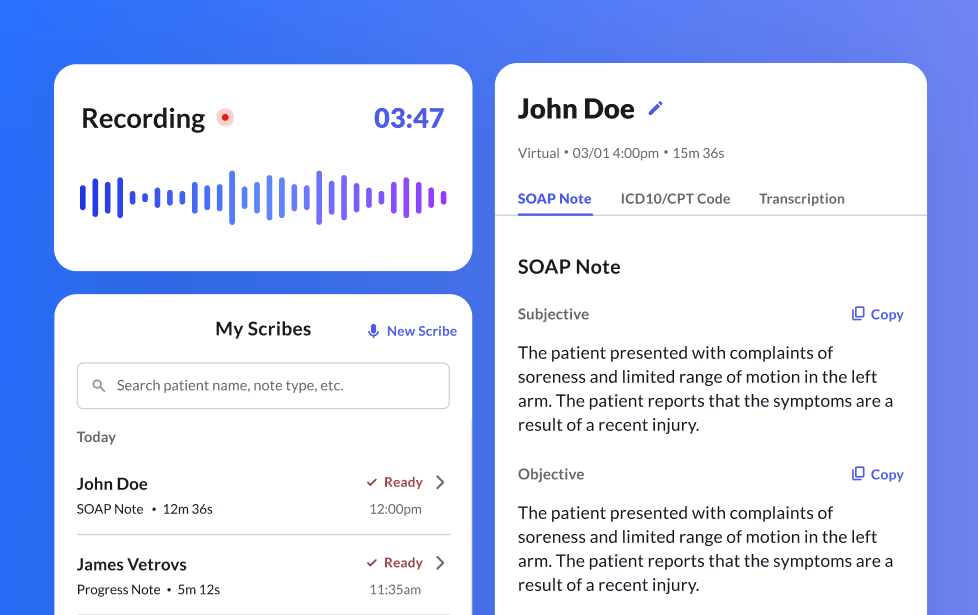
Medical scribe app interface showing a recording waveform, a list of patient notes, and a SOAP note for John Doe.

Stop looking up codes.

Scribe auto-generates them for you.

Try Commure Scribe →

At a glance

Code Family

R53: Malaise and fatigue.

Condition

Weakness

Billable

Yes. R53.1 is a valid code with no child codes and needs no further character.

HCC Mapping (v28)

None. R53.1 does not map to any CMS-HCC v28 category. Within category R53, only R53.2, Functional quadriplegia, maps to a v28 category, HCC 180, Quadriplegia.

Family Specificity

R53 splits into R53.0 for malignancy-related fatigue, R53.1 for weakness, R53.2 for functional quadriplegia and the R53.8- subcodes for other malaise and fatigue. Asthenia NOS indexes to R53.1.

Effective Date

Valid in the FY2026 code set and unchanged in the FY2027 update.

Which R53 code do I assign?

The R53 family splits on which symptom the provider named, not on how severe the presentation is. Weakness, fatigue and malaise each carry their own code, and three Excludes1 codes outside the family take precedence whenever the record names them.

When documentation says…
Code
Generalized weakness, cause not yet established
R53.1
Weakness, the symptom code for diminished muscle strength or reduced functional capacity. The note must record weakness as the presenting complaint or diagnosis. No definitive cause may be established at the time of coding.
Frailty, senile debility or senile asthenia in an older patient
R54
Age-related physical debility. Assign R54 whenever the provider ties the weakness to age. The R53.1 Excludes1 note names R54 for age-related weakness and senile asthenia. The two are not reported together for the same condition.
Generalized muscle weakness
M62.81
Muscle weakness (generalized). Assign this code when generalized muscle weakness is the documented musculoskeletal diagnosis rather than an undifferentiated complaint. The R53.1 Excludes1 note bars reporting it with R53.1 for the same condition.
Sarcopenia, loss of muscle mass with weakness
M62.84
Sarcopenia. Assign this code when the provider documents sarcopenia as the diagnosis. The R53.1 Excludes1 note bars reporting it with R53.1 for the same condition.
Tired, exhausted, no energy
R53.83
Other fatigue. Fatigue means tiredness or exhaustion. Weakness means reduced strength. Code the term the provider documented rather than treating the two as interchangeable.
Weakness on one side following a stroke
Code the sequela of the stroke: the I69 codes, such as the I69.35 codes for hemiplegia and hemiparesis following cerebral infarction, carry the lateralized deficit. Category G81 carries an Excludes1 note for hemiplegia and hemiparesis due to sequela of cerebrovascular disease. R53.1 does not describe a focal post-stroke deficit.
Weakness explained by a documented neuromuscular disease
Code the primary condition: the weakness is integral to that diagnosis. R53.1 is not reported in its place.

Tabular notes

EXCLUDES1

R54: age-related weakness and senile asthenia. Assign R54 when the provider documents the weakness as age-related, frailty, senile debility or senile asthenia. R53.1 and R54 are not reported together for the same condition.

M62.81: muscle weakness (generalized). Assign M62.81 when generalized muscle weakness is the documented musculoskeletal diagnosis. The R53.1 Excludes1 note bars reporting it with R53.1 for the same condition.

M62.84: sarcopenia. Assign M62.84 when loss of muscle mass with weakness is documented as sarcopenia. The R53.1 Excludes1 note bars reporting it with R53.1 for the same condition.

INCLUSION TERM

Asthenia NOS is an inclusion term at R53.1 in the FY2027 tabular. The Index sends Asthenia to R53.1. The Index sends Asthenia, senile to R54. The R53.1 Excludes1 note names senile asthenia (R54).

PRINCIPAL DIAGNOSIS RESTRICTION

Under Section II.A of the FY2027 ICD-10-CM Official Guidelines, R53.1 is not used as the principal diagnosis when a related definitive diagnosis has been established. Code the underlying condition as principal. R53.1 is then reported as an additional code only where weakness is not routinely associated with that condition (Section I.C.18.b).

FY2027: EFFECTIVE 1 OCTOBER 2026

The FY2027 codes addenda make no addition, deletion or revision in category R53. The FY2027 tabular addenda change no instructional note in it. R53.1 is in the FY2027 billable code list and is unchanged in the FY2027 update.

Operational & financial impact

Why specificity matters beyond the chart: risk adjustment, DRG assignment and denial exposure all follow from which code is selected.

CMS-HCC v28 (PY2024+)

No HCC mapping applies to R53.1. The code does not map to any Hierarchical Condition Category in CMS-HCC v28.

Weakness as a symptom code carries no risk adjustment weight.

Captured weight runs through the underlying condition once it is established, not through R53.1.

Medicare and commercial payers

No National Coverage Determination governs weakness coding.

Symptom codes are accepted for outpatient visits where the workup is pending.

R53.1 supports medical necessity for the evaluation that follows an unexplained complaint of weakness. It generates no risk adjustment weight under CMS-HCC v28.

WHERE SPECIFICITY IS LOST

Under its Excludes1 note, R53.1 is not reported with R54, M62.81 or M62.84 for the same condition. Selecting R53.1 where the record documents age-related debility, generalized muscle weakness or sarcopenia states the wrong finding. It also keeps the correct code off the claim.

Interchanging R53.1 and R53.83 records tiredness as reduced strength, or the reverse. The two findings are clinically distinct.

Sequencing R53.1 first when a definitive cause is already documented displaces that definitive diagnosis from the principal position.

Documentation checklist to support R53.1

Chart elements that support code selection and reduce specificity-driven denials.

FAQ

Is R53.1 a billable code?

Yes. R53.1 is a valid billable code for HIPAA-covered transactions. It has no child codes and needs no further character.

What is the difference between R53.1 and R53.83?

Weakness, R53.1, refers to diminished muscle strength or physical capacity. Fatigue, R53.83, refers to a sense of tiredness or exhaustion. Assign R53.83 when the provider documents fatigue. Assign R53.1 when the provider documents weakness or reduced strength.

My elderly patient has generalized weakness. Is R53.1 correct?

That depends on what the note says. Where the provider documents age-related debility, frailty, senile debility or senile asthenia, assign R54 rather than R53.1. The R53.1 Excludes1 note names R54. The two are not reported together for the same condition. Asthenia NOS on its own indexes to R53.1, but senile asthenia is excluded to R54.

Can R53.1 be reported with M62.81 or M62.84?

R53.1 is not reported with M62.81 or M62.84 for the same condition. The R53.1 Excludes1 note names muscle weakness (generalized) (M62.81) and sarcopenia (M62.84). An Excludes1 note means the two codes are not reported together for the same condition. Where the musculoskeletal diagnosis is the documented one, it replaces R53.1 rather than joining it.

Does R53.1 carry any risk adjustment weight under CMS-HCC v28?

No. R53.1 does not map to any Hierarchical Condition Category in CMS-HCC v28. Weakness as a symptom code carries no risk adjustment weight. Weight follows the underlying condition once that condition is established and coded.

Can R53.1 be the principal diagnosis?

It can be sequenced first only where weakness is the reason for the encounter and no related definitive diagnosis has been established. Under Section II.A of the FY2027 Official Guidelines, R53.1 is not the principal diagnosis when the underlying cause is already documented. That underlying condition is coded as principal instead.

Does R53.1 work differently for inpatient and outpatient encounters?

In the outpatient setting, R53.1 may be the principal diagnosis for a complaint-based visit where weakness is the reason for the encounter and no definitive cause is established. On the inpatient side, R53.1 is not used as principal diagnosis once a related definitive diagnosis is established (Section II.A). Where the cause of the weakness remains unknown at discharge, R53.1 may be retained as a principal or secondary diagnosis.

Did anything change for R53.1 in FY2027?

No. R53.1 is unchanged in the FY2027 update, effective 1 October 2026. The FY2027 codes addenda make no addition, deletion or revision in category R53. The FY2027 tabular addenda change no instructional note in it.

Related codes

Codes in the same family as R53.1. Only codes with a published page render as links.

Sibling codes in the R53 family

  • R53.0: Neoplastic (malignant) related fatigue.
  • R53.2: Functional quadriplegia.
  • R53.81: Other malaise.
  • R53.82: Chronic fatigue, unspecified.
  • R53.83: Other fatigue.

Additional codes to consider

Codes outside the R53 family considered alongside R53.1.

Consider instead

  • R54: Age-related physical debility. Excludes1 with R53.1, and the correct code where the weakness is documented as age-related, as frailty or as senile asthenia.
  • M62.81: Muscle weakness (generalized). Excludes1 with R53.1, and the correct code where generalized muscle weakness is the documented musculoskeletal diagnosis.
  • M62.84: Sarcopenia. Excludes1 with R53.1, and the correct code where loss of muscle mass with weakness is documented as sarcopenia.
  • R53.83: Other fatigue. The correct code where the documented complaint is tiredness or exhaustion rather than reduced strength.
  • R53.82: Chronic fatigue, unspecified. The correct code where chronic fatigue is the documented diagnosis.
  • R53.0: Neoplastic (malignant) related fatigue. The correct code where the fatigue is documented as related to a malignancy or its treatment.

Sources

All claims on this page derive from government and professional-standards sources.

Stop looking up codes. Scribe generates them for you.

Commure Scribe listens to your visit and auto-generates billing codes, no manual lookup.