
M25.512

M25.512: Pain in left shoulder

The ICD-10-CM code for left shoulder pain when the record places the pain in the left shoulder joint and no diagnosis explaining it has been established by the end of the encounter.

Billable
FY2027

TABLE OF CONTENTS

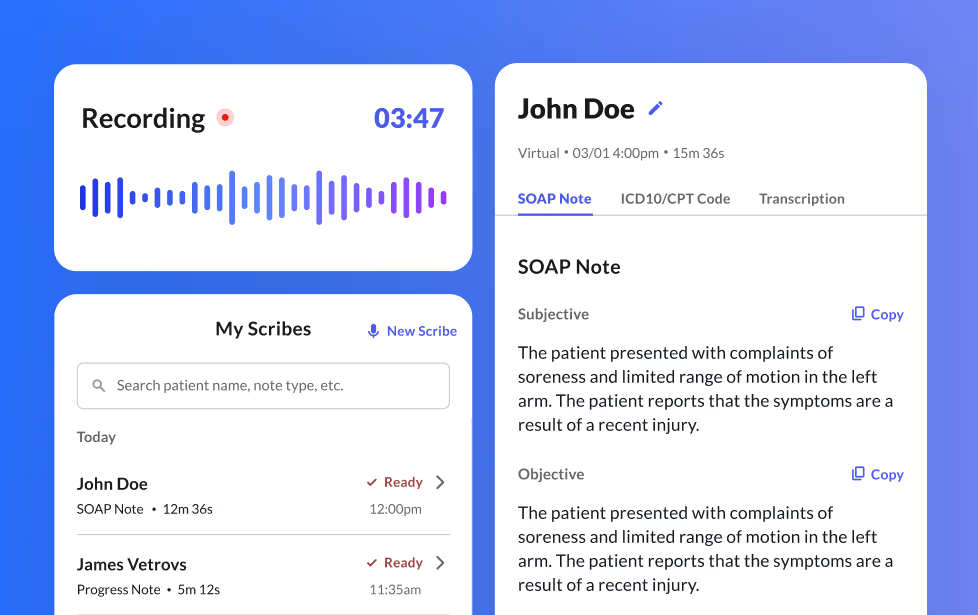
Medical scribe app interface showing a recording waveform, a list of patient notes, and a SOAP note for John Doe.

Stop looking up codes.

Scribe auto-generates them for you.

Try Commure Scribe →

At a glance

Code Family

M25.51: Pain in shoulder.

DRG Grouping

MS-DRG 555 or 556, signs and symptoms of musculoskeletal system and connective tissue with or without MCC, in MDC 08 under the FY2027 MS-DRG v44 grouper.

HCC Mapping (v28)

None. No code in subcategory M25.51 maps to a CMS-HCC v28 category.

Condition

Shoulder pain

Family Specificity

Subcategory M25.51 splits on one axis only, the side. M25.511 is the right shoulder. M25.512 is the left shoulder. M25.519 is the unspecified shoulder.

Billable

Yes. M25.512 is a valid billable code requiring no further characters. It is unchanged in the FY2027 update.

Which M25.51 code do I assign?

Subcategory M25.51 splits on one axis alone: the side of the shoulder the record names. The prior question is whether a cause for the pain has been documented, because a documented cause moves the encounter out of subcategory M25.51 entirely.

When documentation says…
Code
Left shoulder pain", "pain in the L shoulder" or "arthralgia of the left shoulder
M25.512
Pain in left shoulder. Two things have to hold together. The record places the pain in the left shoulder joint. No diagnosis that explains the pain has been established by the end of the encounter.
Shoulder pain" with no side stated anywhere in the record, or "bilateral shoulder pain
M25.519
Pain in unspecified shoulder. Section I.B.13 of the FY2027 Official Guidelines states that codes for the unspecified side should rarely be used. It permits them only where the documentation in the record is insufficient to determine the affected side and it is not possible to obtain clarification. The same section permits the side to be taken from the documentation of clinicians other than the patient's provider. M25.519 is not a bilateral code. Subcategory M25.51 carries none. Pain in both shoulders is reported as M25.511 and M25.512 together, never as M25.519.
Rotator cuff tear on MRI", "supraspinatus tear" or "rotator cuff syndrome
M75.102
Unspecified rotator cuff tear or rupture of left shoulder, not specified as traumatic. The Index sends Tear, rotator cuff (nontraumatic) and Syndrome, rotator cuff to the M75.10 codes. Subcategory M75.1 splits twice. The fifth character carries the extent: 0 for unspecified, 1 for incomplete, 2 for complete. The sixth character carries the side. The left shoulder is therefore M75.102, M75.112 or M75.122. Subcategory M75.1 carries rotator cuff syndrome, supraspinatus syndrome and supraspinatus tear or rupture not specified as traumatic as inclusion terms. It also carries an Excludes1 note for tear of rotator cuff, traumatic (the S46.01 codes). A tear documented as traumatic is classified instead to S46.012 for the tendon or S43.422 for the capsule, each with a seventh character for the encounter.
Frozen shoulder", "adhesive capsulitis" or "global loss of passive range of motion in the left shoulder
M75.02
Adhesive capsulitis of left shoulder. Subcategory M75.0 carries frozen shoulder and periarthritis of shoulder as inclusion terms. One code covers all three wordings. Laterality sits at the fifth character here rather than the sixth. The unspecified shoulder is M75.00 and the right shoulder is M75.01.
Painful arc", "positive Neer or Hawkins sign" or "subacromial impingement
M75.42
Impingement syndrome of left shoulder. The unspecified shoulder is M75.40 and the right shoulder is M75.41. Three neighboring diagnoses take their own subcategories on the same fifth character pattern. Anterior shoulder pain documented as biceps tendinitis is classified to M75.22, bicipital tendinitis of the left shoulder. Subacromial bursitis is M75.52. Calcific tendinitis of the left shoulder is M75.32, which category M25 names in its Excludes2 list.
Glenohumeral osteoarthritis", "degenerative joint disease of the left shoulder" or "end stage shoulder arthritis
M19.012
Primary osteoarthritis, left shoulder. A documented cause displaces the symptom code. Category M19 carries the etiology at the fourth character: 0 for primary, 1 for post-traumatic, 2 for secondary. Post-traumatic osteoarthritis of the left shoulder is M19.112. Secondary osteoarthritis of the left shoulder is M19.212. Category M19 carries an Excludes1 note for polyarthritis (the M15 codes). Where imaging reports osteophytes and the provider states no osteoarthritis diagnosis, the finding is classified to M25.712.
Neck pain radiating into the left shoulder and arm", "C5 radiculopathy" or "cervical radiculitis
M54.12
Radiculopathy, cervical region. Block M20-M25 carries an Excludes2 note for joints of the spine (M40-M54). Pain referred to the shoulder from a cervical root is classified to the dorsalgia codes rather than to subcategory M25.51. Code M54.12 carries no laterality character. The left side is not recorded by the code itself. Subcategory M54.1 carries Excludes1 notes that route the encounter further. Radiculopathy with a cervical disc disorder is classified to the M50.1- codes. Radiculopathy with spondylosis is classified to the M47.2- codes. Neuralgia and neuritis NOS is classified to M79.2. Neck pain documented without radicular features is M54.2.

Tabular notes

EXCLUDES1

No Excludes1 note sits anywhere above M25.512. Code M25.512, subcategory M25.51, subcategory M25.5, category M25, block M20-M25 and chapter 13 each carry none. That was verified against the FY2027 ICD-10-CM tabular. Excludes1 means two codes are not reported together for the same condition. Nothing is barred from appearing on a claim alongside M25.512 on that basis. The Excludes1 notes that matter on a shoulder pain claim sit on the codes a coder reaches for instead. Subcategory M75.1 excludes tear of rotator cuff, traumatic (the S46.01 codes). Subcategory S43.42 carries the reciprocal note for rotator cuff syndrome (complete) (incomplete), not specified as traumatic (the M75.1 codes). A single rotator cuff tear is coded as traumatic or as non-traumatic, not as both. Subcategory M54.1 excludes neuralgia and neuritis NOS (M79.2), radiculopathy with cervical disc disorder (M50.1), radiculopathy with lumbar and other intervertebral disc disorder (M51.1-) and radiculopathy with spondylosis (the M47.2 codes). Category M19 excludes polyarthritis (the M15 codes).

EXCLUDES2

Subcategory M25.5 carries five Excludes2 notes: pain in hand (M79.64-), pain in fingers (M79.64-), pain in foot (M79.67-), pain in limb (M79.6-) and pain in toes (the M79.67 codes). Subcategory M79.6 carries the reciprocal note for pain in joint (the M25.5 codes). The pair is symmetrical. It is the axis a shoulder pain claim turns on. Pain in the shoulder joint is classified to the M25.51- codes. Pain in the limb around the joint is classified to the M79.6- codes, where pain in the left arm is M79.602 and pain in the left upper arm is M79.622. Subcategory M79.62 carries pain in axillary region as an inclusion term. Excludes2 means the patient may carry both at once. A record that documents left shoulder joint pain and separately documents left upper arm pain supports M25.512 alongside M79.622.

Category M25 carries seven Excludes2 notes: abnormality of gait and mobility (R26.-), acquired deformities of limb (M20-M21), calcification of bursa (M71.4-), calcification of shoulder (joint) (M75.3), calcification of tendon (M65.2-), difficulty in walking (R26.2) and temporomandibular joint disorder (the M26.6 codes). The calcification note is the one that reaches a shoulder pain claim. Calcific tendinitis of the left shoulder is M75.32. Excludes2 does not bar it from the same claim as M25.512. Guideline I.B.5 still bars the pain code where the pain is routinely associated with the calcific tendinitis. Category M75 carries one Excludes2 note, for shoulder-hand syndrome (the M89.0 codes). Block M20-M25 carries one, for joints of the spine (M40-M54). Chapter 13 carries ten, among them injury, poisoning and certain other consequences of external causes (S00-T88) and symptoms, signs and abnormal clinical and laboratory findings, not elsewhere classified (R00-R94). Those last two are why a shoulder contusion code from the S40.01- range and a musculoskeletal sign code from R29.898 may each appear on the same claim as M25.512 when both are documented.

USE ADDITIONAL

Chapter 13 carries a chapter level instruction: use an external cause code following the code for the musculoskeletal condition, if applicable, to identify the cause of the musculoskeletal condition. Code M25.512, subcategory M25.51, subcategory M25.5 and category M25 carry no Use Additional instruction of their own. They carry no Code Also and no Code First instruction either. Subcategory M25.51 and code M25.512 carry no inclusion term and no Includes note in the tabular.

FY2027: EFFECTIVE 1 OCTOBER 2026

M25.512 is unchanged in the FY2027 update, effective 1 October 2026. The FY2027 codes addenda add, delete or revise no code in category M25. The FY2027 tabular still carries subcategory M25.51 with no notes of its own. Subcategory M25.5 still carries the same five Excludes2 notes. One change reaches this page's differential. FY2027 deletes M86.8X1, other osteomyelitis, shoulder, and replaces it with side-specific codes. The left shoulder code is M86.8X12.

Operational & financial impact

Why specificity matters beyond the chart: risk adjustment, DRG assignment and denial exposure all follow from which code is selected.

CMS-HCC v28 (PY2024+)

M25.512 carries no CMS-HCC v28 mapping.

No code in subcategory M25.51 maps to a v28 category. Naming the left side changes nothing in a Medicare Advantage risk score. Moving from M25.519 to M25.512 is a compliance and medical necessity gain rather than a risk adjustment gain.

Naming the cause does not reliably change it either. The three v28 categories in this clinical area are HCC 92 for bone, joint, muscle and severe soft tissue infections and necrosis, HCC 93 for rheumatoid arthritis and other specified inflammatory rheumatic disorders, and HCC 94 for systemic lupus erythematosus and other specified systemic connective tissue disorders. The mechanical shoulder differential sits outside all three. A complete rotator cuff tear at M75.122 carries no v28 HCC. Adhesive capsulitis at M75.02 carries none. Impingement syndrome at M75.42 carries none. Bicipital tendinitis at M75.22 carries none. Glenohumeral osteoarthritis at M19.012 carries none. Cervical radiculopathy at M54.12 carries none.

The infective and inflammatory causes are where the v28 weight sits in this differential. Staphylococcal arthritis of the left shoulder at M00.012 maps to HCC 92. Other osteomyelitis of the shoulder mapped to HCC 92 at M86.8X1, which FY2027 replaced with side-specific codes. The left shoulder code, M86.8X12, postdates the v28 crosswalk available here. Its mapping is indeterminate. Rheumatoid arthritis of the left shoulder maps to HCC 93, at M06.012 without rheumatoid factor and at M05.712 with it. Each of those categories is reached through the named diagnosis, never through M25.512.

CMS calculates 100 percent of CY2026 risk scores using the 2024 CMS-HCC model, completing the three year phase in, per the CY2026 Medicare Advantage and Part D Rate Announcement.

MS-DRG v44 (FY2027)

MS-DRG 555: signs and symptoms of musculoskeletal system and connective tissue with MCC.

MS-DRG 556: signs and symptoms of musculoskeletal system and connective tissue without MCC.

An inpatient admission with M25.512 as the principal diagnosis groups to MS-DRG 555 or 556 in MDC 08 under the FY2027 MS-DRG v44 grouper. Both sit in the medical partition.

The pair splits on MCC alone. There is no CC tier between 555 and 556. Severity weight on such an admission comes from comorbidities documented elsewhere in the record rather than from the shoulder pain code.

A symptom code in the principal position is what produces this pair. Where the admission works the shoulder pain up to a cause, that cause becomes the principal diagnosis. The case then leaves 555 and 556.

The differential moves the case to a different pair. Glenohumeral osteoarthritis at M19.012 groups to MS-DRG 553 or 554, bone diseases and arthropathies with or without MCC. A non-traumatic rotator cuff tear at M75.122, adhesive capsulitis at M75.02 and impingement syndrome at M75.42 each group to MS-DRG 557 or 558, tendonitis, myositis and bursitis with or without MCC. Cervical radiculopathy at M54.12 groups to MS-DRG 073 or 074, cranial and peripheral nerve disorders with or without MCC, in MDC 01.

Medicare and commercial payers

M25.512 is a billable code. It is valid on a claim when the record supports no more specific code.

Section I.B.4 of the FY2027 ICD-10-CM Official Guidelines states that codes describing symptoms and signs are acceptable for reporting purposes when a related definitive diagnosis has not been established by the provider. Section I.B.18 states that sign, symptom and unspecified codes have acceptable, even necessary, uses.

Section I.B.13 sets a tighter rule for the side than Section I.B.18 sets for the diagnosis. It states that codes for the unspecified side should rarely be used. It permits them only where the documentation in the record is insufficient to determine the affected side and it is not possible to obtain clarification. Where laterality is not documented by the patient's provider, the same section permits the affected side to be taken from the documentation of other clinicians. Conflicting documentation calls for a provider query.

Section I.B.14 lists laterality among the exceptions to provider only code assignment. Therapy notes, imaging reports and nursing assessments are therefore in scope for establishing the side before a query is raised. The associated diagnosis still has to come from the patient's provider.

WHERE SPECIFICITY IS LOST

M25.512 records the side. What it gives up is the diagnosis. Shoulder pain is a presenting sign with a large coded differential. Every entry in that differential carries its own code, its own laterality character and its own coverage terms.

Rotator cuff pathology is the first substitution to check. Subcategory M75.1 carries the extent at the fifth character and the side at the sixth. A complete tear of the left rotator cuff is M75.122. An incomplete tear is M75.112. A tear documented without a stated extent is M75.102. That unspecified digit is a second loss of specificity layered on the first.

The traumatic split sits beside it. Subcategory M75.1 carries an Excludes1 note for tear of rotator cuff, traumatic (the S46.01 codes). Subcategory S43.42 carries the reciprocal note for rotator cuff syndrome (complete) (incomplete), not specified as traumatic (the M75.1 codes). One tear supports one branch or the other, not both.

Adhesive capsulitis, impingement, biceps tendinitis and bursitis each carry their own subcategory in category M75. Frozen shoulder on the left is M75.02. Impingement syndrome on the left is M75.42. Bicipital tendinitis on the left is M75.22. Bursitis on the left is M75.52. Calcific tendinitis on the left is M75.32.

Glenohumeral osteoarthritis changes the encounter furthest. Once the provider documents osteoarthritis of the left shoulder, M19.012 replaces M25.512. Section I.B.5 of the Official Guidelines states that signs and symptoms associated routinely with a disease process should not be assigned as additional codes, unless otherwise instructed by the classification. Pain is associated routinely with glenohumeral osteoarthritis.

The cervical spine is the referred pain trap. Pain arising from a cervical root can be recorded in the note as shoulder pain. Block M20-M25 carries an Excludes2 note for joints of the spine (M40-M54). Cervical radiculopathy is M54.12, which carries no laterality character at all. Cervicalgia without radicular features is M54.2. Cervicobrachial syndrome is M53.1.

M25.519 is the larger loss inside the family. It gives up the side on a joint the examining provider has already identified. The unspecified side code therefore records a gap in the note rather than a gap in clinical knowledge. One word recovers it.

Bilateral involvement is a further loss. Subcategory M25.51 carries no bilateral code. Both shoulders take M25.511 and M25.512 together, never M25.519.

The limb boundary is the last one. Subcategory M25.5 and subcategory M79.6 carry reciprocal Excludes2 notes. A note reading left upper arm pain rather than left shoulder pain supports M79.622, where subcategory M79.62 carries pain in axillary region as an inclusion term. Left arm pain with no segment named supports M79.602.

Documentation checklist to support M25.512

Chart elements that support code selection and reduce specificity-driven denials.

FAQ

What is the ICD-10 code for left shoulder pain?

The code for left shoulder pain is M25.512, pain in left shoulder. It is a valid billable code and requires no further characters. The right shoulder is M25.511. A record that never names a side supports only M25.519, pain in unspecified shoulder. M25.512 applies when the pain is placed in the shoulder joint and no diagnosis explaining it has been established by the end of the encounter.

When does a diagnosis replace M25.512?

A diagnosis replaces M25.512 as soon as the provider documents a cause. A non-traumatic rotator cuff tear on the left is M75.122 when complete, M75.112 when incomplete and M75.102 when the extent is not stated. Adhesive capsulitis is M75.02. Impingement syndrome is M75.42. Bicipital tendinitis is M75.22. Bursitis is M75.52. Calcific tendinitis is M75.32. Glenohumeral osteoarthritis is M19.012 when primary, M19.112 when post-traumatic and M19.212 when secondary. An osteophyte reported on imaging with no osteoarthritis diagnosis stated is M25.712. Section I.B.4 of the Official Guidelines accepts symptom codes when a related definitive diagnosis has not been established by the provider. Section I.B.5 states that signs and symptoms associated routinely with a disease process should not be assigned as additional codes.

Is shoulder pain coming from the neck coded to M25.512?

No. Where the provider attributes the pain to a cervical root, the encounter is coded to M54.12, radiculopathy, cervical region. That is the same framing the M25.511 page carries for the right shoulder. Block M20-M25 carries an Excludes2 note for joints of the spine (M40-M54). Code M54.12 carries no laterality character. The left side is not recorded by the code itself. Subcategory M54.1 carries Excludes1 notes that route the encounter further. Radiculopathy with a cervical disc disorder is classified to the M50.1- codes. Radiculopathy with spondylosis is classified to the M47.2- codes. Neck pain documented without radicular features is M54.2.

Does M25.512 map to a CMS-HCC v28 category?

No. M25.512 carries no CMS-HCC v28 mapping and no code in subcategory M25.51 does either. Documenting the left side does not change a Medicare Advantage risk score. Most of the shoulder differential does not change it either. A complete rotator cuff tear at M75.122, adhesive capsulitis at M75.02, impingement syndrome at M75.42, bicipital tendinitis at M75.22, glenohumeral osteoarthritis at M19.012 and cervical radiculopathy at M54.12 each carry no v28 HCC. The infective and inflammatory causes are the exception. Staphylococcal arthritis of the left shoulder at M00.012 maps to HCC 92, bone, joint, muscle and severe soft tissue infections and necrosis. Rheumatoid arthritis of the left shoulder at M06.012 maps to HCC 93, rheumatoid arthritis and other specified inflammatory rheumatic disorders.

What must the note show to support M25.512?

The note must show three things at once. The pain is located in the shoulder joint rather than in the upper arm, the axilla or the neck. The record names the left side. No diagnosis explaining the pain has been established by the end of the encounter. Any one of the three failing moves the encounter to a different code.

Why is M25.519 not a safe default when the side is missing?

M25.519 is not a safe default because the examining provider has already identified which shoulder is involved. Section I.B.13 of the FY2027 Official Guidelines states that codes for the unspecified side should rarely be used. It permits them only where the documentation in the record is insufficient to determine the affected side and it is not possible to obtain clarification. Where the provider has not documented the side, the same section permits it to be taken from the documentation of other clinicians. Section I.B.14 lists laterality among the exceptions to provider only code assignment. Conflicting documentation calls for a provider query rather than for M25.519. M25.519 is also not a bilateral code. Pain in both shoulders is reported as M25.511 and M25.512 together, because subcategory M25.51 carries no bilateral code.

How does M25.512 sequence and group on inpatient and outpatient claims?

As a principal diagnosis M25.512 groups to MS-DRG 555 or 556 in MDC 08 under the FY2027 MS-DRG v44 grouper, signs and symptoms of musculoskeletal system and connective tissue with or without MCC. The pair splits on MCC alone and there is no CC tier. Where the admission establishes a cause, that cause is sequenced as the principal diagnosis. The case then leaves the pair. Glenohumeral osteoarthritis groups to MS-DRG 553 or 554. A non-traumatic rotator cuff tear, adhesive capsulitis and impingement syndrome each group to MS-DRG 557 or 558. Cervical radiculopathy coded to M54.12 groups to MS-DRG 073 or 074 in MDC 01. The selection rule is the same in the outpatient setting. The difference lies in how uncertainty is handled. An outpatient encounter codes only what is confirmed. An inpatient discharge diagnosis documented as probable or suspected may be coded as though confirmed under UHDDS rules.

Did M25.512 change in FY2027?

M25.512 is unchanged in the FY2027 update, effective 1 October 2026. The update also leaves subcategory M25.51 unchanged, and the FY2027 tabular still carries M25.51 with no notes of its own. The FY2026 update, effective 1 October 2025, left the descriptor of M25.512 and the Excludes notes above it unchanged. Subcategory M25.51 gained and lost no codes in FY2026.

Related codes

Codes in the same family as M25.512. Only codes with a published page render as links.

Sibling codes in the M25.51 family

  • M25.511: Pain in right shoulder.
  • M25.512: Pain in left shoulder.
  • M25.519: Pain in unspecified shoulder.

Additional codes to consider

Codes outside the M25.51 family considered alongside M25.512.

Companion: code alongside when documented

  • M25.511: Pain in right shoulder, reported with M25.512 when both shoulders are painful, because subcategory M25.51 carries no bilateral code.
  • M79.622: Pain in left upper arm, permitted alongside M25.512 under the reciprocal Excludes2 notes at M25.5 and M79.6 when both joint pain and upper arm pain are documented.
  • M79.602: Pain in left arm, on the same Excludes2 terms.
  • G89.29: Other chronic pain, where the shoulder pain is documented as chronic.
  • G89.21: Chronic pain due to trauma, where the chronic pain follows a documented injury.
  • G89.4: Chronic pain syndrome, where the record documents chronic pain syndrome.

Consider instead

  • M25.511: Pain in right shoulder, where the record documents the right side.
  • M25.519: Pain in unspecified shoulder, where the record names no side and clarification cannot be obtained.
  • M75.122: Complete rotator cuff tear or rupture of left shoulder, not specified as traumatic.
  • M75.112: Incomplete rotator cuff tear or rupture of left shoulder, not specified as traumatic.
  • M75.102: Unspecified rotator cuff tear or rupture of left shoulder, not specified as traumatic, where the extent is not stated.
  • S46.012A: Strain of muscle(s) and tendon(s) of the rotator cuff of left shoulder, initial encounter, where the tear is documented as traumatic.
  • S43.422A: Sprain of left rotator cuff capsule, initial encounter.
  • M75.02: Adhesive capsulitis of left shoulder, which carries frozen shoulder and periarthritis of shoulder as inclusion terms.
  • M75.42: Impingement syndrome of left shoulder.
  • M75.22: Bicipital tendinitis, left shoulder.
  • M75.52: Bursitis of left shoulder.
  • M75.82: Other shoulder lesions, left shoulder.
  • M75.92: Shoulder lesion, unspecified, left shoulder.
  • M19.012: Primary osteoarthritis, left shoulder.
  • M19.112: Post-traumatic osteoarthritis, left shoulder.
  • M19.212: Secondary osteoarthritis, left shoulder.
  • M25.712: Osteophyte, left shoulder, where imaging reports osteophytes and no osteoarthritis diagnosis is stated.
  • M24.112: Other articular cartilage disorders, left shoulder, for a labral or cartilage lesion documented without an injury.
  • M24.812: Other specific joint derangements of left shoulder, not elsewhere classified.
  • M24.412: Recurrent dislocation, left shoulder.
  • M65.812: Other synovitis and tenosynovitis, left shoulder.
  • M71.812: Other specified bursopathies, left shoulder.
  • M54.12: Radiculopathy, cervical region, where the shoulder pain is referred from a cervical root.
  • M54.2: Cervicalgia, where neck pain is documented without radicular features.
  • M53.1: Cervicobrachial syndrome.
  • M50.10: Cervical disc disorder with radiculopathy, unspecified cervical region, where a cervical disc disorder is the documented cause.
  • M47.22: Other spondylosis with radiculopathy, cervical region, where cervical spondylosis is the documented cause.
  • M00.012: Staphylococcal arthritis, left shoulder, which maps to HCC 92 in CMS-HCC v28.
  • M06.012: Rheumatoid arthritis without rheumatoid factor, left shoulder, which maps to HCC 93 in CMS-HCC v28.
  • M05.712: Rheumatoid arthritis with rheumatoid factor of left shoulder without organ or systems involvement, which maps to HCC 93 in CMS-HCC v28.
  • M10.012: Idiopathic gout, left shoulder.
  • M13.812: Other specified arthritis, left shoulder.
  • M35.3: Polymyalgia rheumatica.
  • M89.022: Algoneurodystrophy, left upper arm, which carries shoulder-hand syndrome as an inclusion term and which category M75 names in its Excludes2 list.
  • M86.8X12: Other osteomyelitis, left shoulder, new in the FY2027 update. It replaced M86.8X1, which maps to HCC 92 in CMS-HCC v28.
  • S40.012A: Contusion of left shoulder, initial encounter.
  • S43.012A: Anterior subluxation of left humerus, initial encounter.
  • S42.212A: Unspecified displaced fracture of surgical neck of left humerus, initial encounter for closed fracture.
  • I20.9: Angina pectoris, unspecified, where the provider attributes the left shoulder pain to cardiac ischemia rather than to the shoulder joint.
  • R07.9: Chest pain, unspecified, where the documented site is the chest rather than the shoulder.

Sources

All claims on this page derive from government and professional-standards sources.

Stop looking up codes. Scribe generates them for you.

Commure Scribe listens to your visit and auto-generates billing codes, no manual lookup.